Balloons Over the Bosque

Guest blog by Ray Shortridge.

The rift valley of the Rio Grande del Norte makes Albuquerque an addictive destination for hot air balloonists. Every fall, Albuquerque hosts the International Balloon Fiesta and balloonists come from all over the world to show off their ballooning skills. An ideal ballooning environment is caused by the Sandia Mountain Range shading the valley for a couple of hours after dawn.

This keeps the cool night air from rapidly warming up, thereby prolonging the buoyancy of the hot air balloon. Balloonists launching at daybreak can enjoy a lengthy ride viewing the Rio Grande, the river’s bosque (the longest cottonwood canopy in world), the lights of an awakening city, and the mountains.

Balloonists inflate the balloons by using fans to blow hot air generated by liquid propane gas into the envelope or bag. At night, during Balloon Fiesta, owners often tether their balloons to the ground with the burners lit, which makes a dramatic sight and is known as a “Ballon Glow”.

People often hire commercial balloonists such as Rainbow Ryders to take them up to enjoy the heady experience of unpowered flight. Often this is followed by a champagne toast. If you’re up for this adventure, make sure to wear a hat. Those burners are hot! In fall, winter, or spring, wear layers The early morning air at full altitude may be cool but it will likely warm up during your ride.

The balloon on the left seemed to follow me down a trail in the bosque, reminding me of the cult British TV show, The Prisoner.

When the balloonist ignites the propane burner to reheat the air in the bag, it sounds like a dragon is approaching. The roar can be a bit unsettling because one can hear it before before the balloon comes into view over a ridge line of copse of trees. A bevy of balloons make a great roar

Balloonists like to hover over the river. The waterfowl don’t seem to mind.

Thousands of balloonists from all over the world will once again rendezvous in Albuquerque this October for nine days and two weekends. It’s a spectacle worth seeing. Have you seen the new special shapes? They rock.
Holy Fortune for Hire

The Torri gates of Kyoto are a well loved Shinto shrine. The beautiful vermillian gates line the hills in a seemingly never ending parade of requests for the gods to bless companies and families. This Fushimi Inari Taisha (伏見稲荷大社) shrine sells the beautiful gates for anywhere between $4,000 USD (400,000 yen) for a small gate far up the hill to $13,000 USD (1,300,000 yen) for a large one closer in.

The names of the donor companies are inscribed in black ink on the side.

A fun animal statue at the shrine. Foxes are more common but pug dogs coexist.
Before praying, ring the bell to be sure the gods are listening

The earliest structures existed around 711 on a nearby hill but were relocated later. Since 1499, this shrine has accepted prayers to the god of grains. Only later, did it expand to prayers for business success. The vermilion color represents the sun.

10,000 gates stand together like trees in a forest

A fox statue protecting the grains.

Another fox with a key in his mouth
A map to the Kyoto gates shows how extensive they are
Visitors can buy miniature paper gates and hang them here with their prayers

For hale and hearty visitors, a walk up the hiking trails among the gates quickly takes you away from the crowds and provides beautiful views of Kyoto. While Kyoto is the main temple, there are sub-shrines around Japan, including one in Tokyo.

Busses are an Affordable Passport to Japan.

Guest blog by Ray Shortridge

Public busses are a convenient way to move about large Japanese cities. Their routes have stops near most of the sites that you would want to visit. Better yet, the busses are scrupulously clean and comfortable to ride in. In general, they are full but not unbearably crowded. Rush hour can be another matter so claustrophobic tourists should definitely avoid public transit during peak travel hours.

The fare is paid with a plastic IC card that is purchased from a ticket machine at a railroad station. The machines have an English option for operations.

One of the ticket machines
Various types of IC cards

The initial cost is a refundable deposit of 500 yen plus whatever amount you wish to credit to the card, typically another 1,500 yen. Using the card saves you from the inconvenience of buying a ticket every time you want to take a bus (or a train that honors the card.)

To use the card, tap it against the panel at the front of the bus near the driver when exiting the bus. In most cities, enter the bus from the side door and exit through the front. Note: because one pays as one exits, getting off the back door is considered theft. Don’t do it.

Touring Japan by bus, can be manageable and pleasurable. Better yet, it is extremely affordable.

Find the Doggie in the Garden

These spidery flowers are celebrated with their own festival

Among all the hubbub of Japan’s big cities, the bits of green here and there make it calmer and more enjoyable

A beautiful flower along the way
Houses and shops find ways to include nature
Flowers brightened our walks

Doggy all dressed up in a kimona and carrying his own flowers
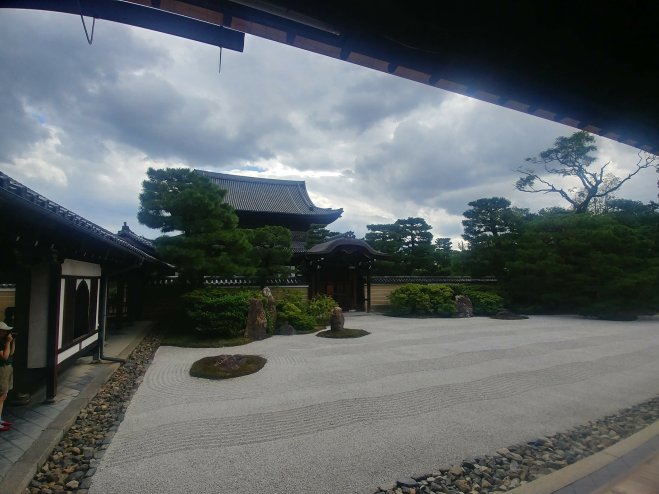
A Zen garden at one of the shrines we visited
Real life bonsai
And a flower to finish off the day and the post

Japanese Convenience

Guest blog by Ray Shortridge

A sample convenience store meal. These sandwiches are delicious but oddly, always served on white bread with the crusts removed.

When working in Cleveland during a summer break from college, I purchased milk and sundries from a nearby Lawson’s convenience store. Lawson stores are no longer found in the continental US, but to my surprise, they abound in Japan. Nowadays, 7-Eleven stores in the US are owned by a Japanese company, and, along with Family Mart, compete with Lawsons.

All told, there are more than 50,000 convenience stores in Japan. And they are convenient, abounding on commercial streets and in railroad stations and offering an ever changing array of snacks, sandwiches, ice cream, fruit and soda beverages, cigarettes, cold beer, candy, and international ATMs. Many ATMs throughout Japan won’t work with foreign ATM cards. Fortunately, this is an area where Japanese 7-11 stores shine. Google maps or a 7-11 finder app can help you find the 7-11 nearest you.

While ATMs at Family Mart, Lawson, and others may not support international cards, they offer many of the same useful services for foreigners as 7-11 stores including: currency exchange, free Wi-Fi, and ability to use credit cards for purchases.

Moreover, one can top off public transportation cards there and access the internet on Wi-Fi. Japanese convenience stores are truly a phenomenon.

Platinum pen convertor easy fix

I love my Japanese made Platinum pens but I had a couple of their convertors that were terribly balky and hard to twist. Here’s an easy fix. You’ll need some silicon grease, and that’s all. Please be careful to only put the grease on the convertor piston above the ink seal. Make sure you wash your hands extremely well before touching the nib, feed, etc. If you do that, you’ll find this very easy.

Silicon grease. This one is from my twsbi kit


The metal section removed from convertor but the pen is inked. Not good!

Unless you want an inky mess, do not try this on an inked pen. Did I learn that from experience? What do you think? Gently take the convertor apart, trying to remember how it goes together (I’ll review it, but it makes it easier if you try to remember.) I crank the piston all the way up to the top, as far away from the nib as possible. Then I take off the metal housing (3). At this point, you can just grease the extended piston (1), and put it back together. But sometimes the top two pieces (2 and 4) pop out. Don’t panic! It’s ok. You’ll actually have a better functioning convertor if you grease 2 and 4 where they meet.

So if they did come out, just take part 2 and push the ribbed part (to the right in this photo) up through the larger opening in the metal housing (3) until it extends out the smaller opening. Then pop #4 on top of part two (where it’s inside the housing.) I’ve never noticed a right side to part 4, but just in case I’ve been extremely lucky, just flip it if the first side doesn’t work.

Now hold the combo of 2, 3, and 4 horizontally, and screw it over the piston. It helps to do all this horizontally so parts don’t shift but you may find another orientation works better for you. Your convertor should now work smoothly (unless something else is wrong, like a bent piston or missing piece.)

Congratulations! You’re now a Platinum pen convertor repair rock star.

Buy Anything Imaginable in Tokyo’s Market

All my friends have been wondering “where are the market pictures?” Well here they are. This is the retail market ( as opposed to the wholesale fish market that is more famous and is moving soon.) I’ll add an occasional caption, but the pictures speak for themselves. Enjoy a quick walk through the market. This is a small fraction of the sites. It is huge!

The ceiling is colorful

These capsule stations were everywhere for kids. The content varied.

Getting Around in Japan — You Can Do it without Japanese


Guest blog by Ray Shortridge


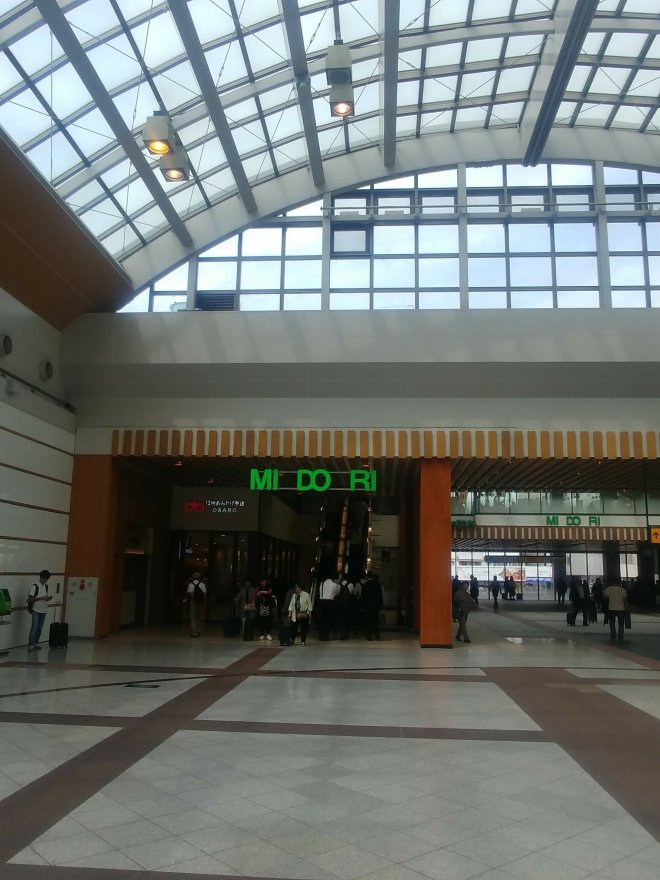
Train Boards have enough information for English speakers

A commonly held view is that one has to be fluent in Japanese to get around in Japan. After our couple of weeks there, we felt confident that could navigate the train system to travel between cities and towns across the country and commuter trains within urban areas. Here’s why.

The flagship (to mix the metaphor) of Japanese Rail (JR) is the world renowned bullet train and connects the major cities in Japan.

JR owns and operates about 70% of rail mileage in Japan and provides local and express service.

Several private railroad lines complement JR’s service by providing commuter trains throughout the larger metro areas. (For an in-depth look at the railroad system, click on this link.)

Finding the train one wants in the station is easy. An large electric sign in the entrance hall provides the train number and destination in English, as well as Japanese, and the tracks are designated by arabic numerals.

Directional signage within the building are also in English, as well as Japanese.

At the track, the updated arrival and departure signs are in English.

The ticket indicates the number for the car in which you are seated,and markings on the platform show where the doors on the car are located. The trains stop exactly at the door markings. Passengers line up here and enter in an orderly fashion.

Sample tickets and a rail pass
Train car door markings. Note: the yellow raised strips help blind passengers find their trains.

Japan is an orderly society and respects queues, so cutting into a line or jumping one’s place is unacceptable. The passenger cars are spacious, tidy, and comfortable.

JR is in the process of implementing wifi service and outlets for ac/dc adapters on the bullet trains.

The commuter trains (and busses) in Tokyo and other metro areas use an electronic pass that is tapped against a reading device, rather than a ticket. There are several versions. The one we used is a Pasmo card which can also be used to purchase things like drinks from vending machines and items in some stores. Tickets can be purchased at machines in the station, and JR also issues passes for multiple trips.

The Japanese train network is extensive. Wikipedia provides an excellent overview.

Fortunately, once a tourist has used a particular type of train once, venturing forth again was straight forward and enjoyable. Foreigners should try to avoid peak travel times for local trains, however, to avoid uncomfortably crowded cars when train pushers are required.

Travel by Tram

Albuquerque has spectacular views from its extremely safe Sandia tramway. According to the tramway, “it ascends from a base elevation of 6,559 feet (1,999 m) to a top elevation of 10,378 feet (3,163 m).

The tram reaching the top.
Great views
More great views from a trail near the tram
Great views at the top
The leaves are starting to turn at the top of the mountaim
Many folks ride the tram up and hike, ski, or bicycle down.
This heavy equipment looked like it was balanced on a sinkhole
A new restaurant is being built to replace the old one on top of the tramway
My brother and his husband seemed to enjoy the views

Afterwards, we stopped for food and drinks at the delightful Sandiago Grill at the base of the tram. In addition to fabulous views from inside and outside seating, their menu offerings have been jazzed up. The prices seemed a little higher than the last time I was there but are reasonable for the quality. My fish tacos were delicious. Unfortunately, this picture was taken after I’d messed up their plating. Forgive me, I was hungry!

Soba Students

The materials ready to make soba noodles (buckwheat)
Ray kneading the dough into submission
The instructor cutting the noodles

As you might imagine, our noodles weren’t done as quickly or as evenly as the instructor’s. It was a easy-sounding process in theory: lean the knife into the dough, cut, repeat. In reality, not so easy.

Finished soba noodle soup and accompanying tempura

The soup can be served hot or cold. In this case it was cold. While I much prefer it hot, cold soba soup and eels are considered cooling dishes for hot days.